Leading With Purpose and Energy: The Foundation of Ikigai Leadership
This is the first article in a five-part series exploring how Ikigai Leadership and the Energy Leadership Index can help leaders align purpose, energy, and impact.
Most leaders can tell you what they're working toward. Fewer can clearly articulate why it matters to them and even fewer stop to consider the energy they bring while pursuing it. Yet that distinction can make all the difference.
Over the years, I've worked with leaders across industries and levels, from emerging leaders stepping into management for the first time to seasoned executives leading through growth, change, acquisitions, and uncertainty.
What I've learned is that leadership challenges are not always about capability. Many leaders already know what they value. They care deeply about their people. They believe in the mission. They want to make a positive impact. Yet two leaders with similar goals, values, and intentions can create very different experiences for the people around them.
One leader inspires trust, engagement, and growth. Another unintentionally creates frustration, burnout, confusion, or resistance. The difference is often not their purpose. It's the energy from which they lead.
What Is Ikigai Leadership?
The Japanese concept of Ikigai is often translated as "reason for being."
At its core, Ikigai invites us to reflect on four important questions:
What do I love?
What am I good at?
What does the world need?
What can I be rewarded for?
When these dimensions align, people often experience a greater sense of meaning, fulfillment, and direction in their work and lives.
For leaders, Ikigai can serve as a powerful compass. It helps connect personal values, strengths, passions, and contributions to something larger than a title, promotion, or quarterly goal.
The Ikigai Framework: Finding Your Leadership North Star
At the heart of Ikigai are four key dimensions. When they intersect, they reveal your Ikigai which is your reason for being and the unique value you’re here to contribute.
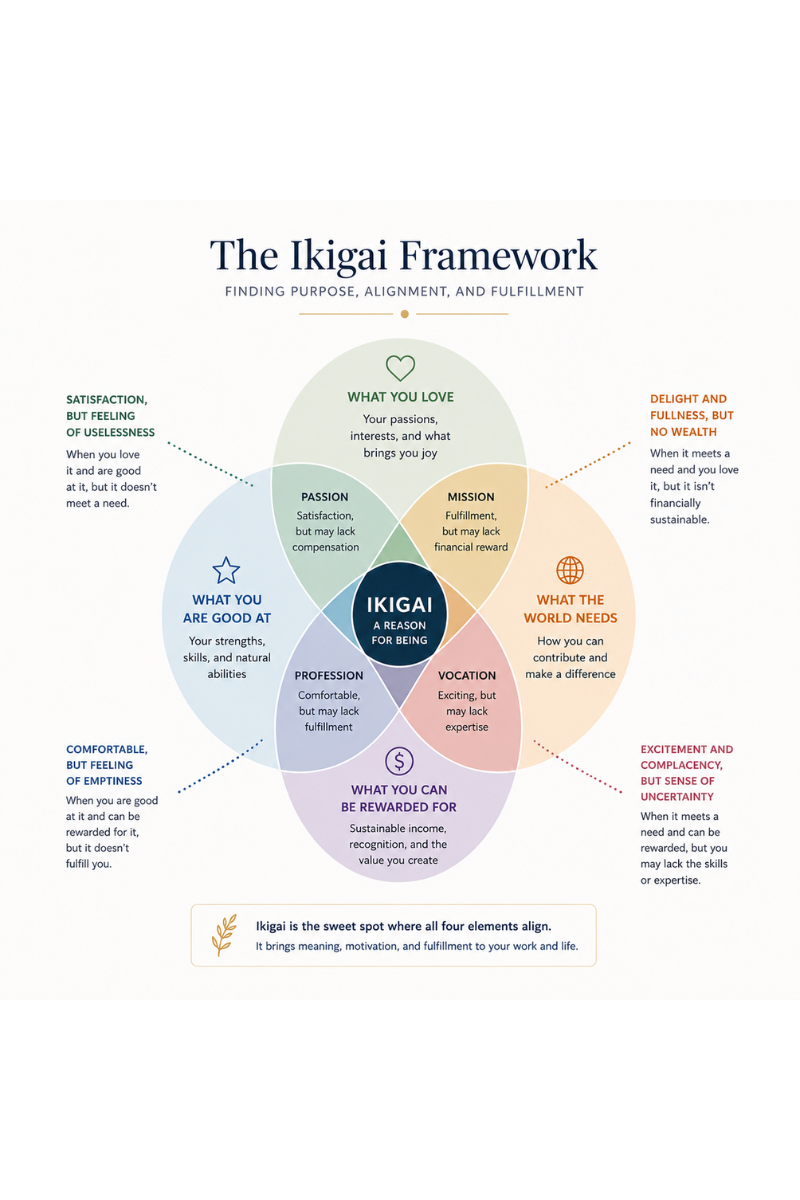
The Ikigai Framework illustrates how purpose emerges at the intersection of what you love, what you're good at, what the world needs, and what you can be rewarded for.
When leaders understand their purpose, they often lead with greater intention. They make decisions more confidently. They communicate more authentically. They remain connected to what matters most, even during periods of uncertainty or change.
But purpose alone is not enough. I've worked with many leaders who have a strong sense of purpose and still struggle with difficult conversations, decision-making, communication challenges, burnout, conflict, or team dynamics.
Purpose tells us where we want to go.
It doesn't necessarily determine how we get there.
The Missing Piece: Energy
This is where the Energy Leadership Index (ELI) offers another valuable perspective.
The ELI framework helps us understand that our thoughts, emotions, perceptions, and behaviors are influenced by different energetic states. These energetic states shape how we interpret situations, respond to challenges, communicate with others, and ultimately lead.
Imagine two leaders facing the exact same situation. Both care deeply about their employees. Both want the best outcome. Both believe in the organization's mission.
One becomes overwhelmed by the emotional weight of the decision and delays taking action. The other approaches the situation with clarity, accountability, and a focus on what will best serve the organization over the long term.
Neither leader necessarily cares more than the other. Neither leader is more committed to the mission. The difference may simply be the energy from which they are leading.
Why Purpose and Energy Must Work Together
One of the reasons I find the combination of Ikigai and ELI so compelling is that it helps explain a pattern I see repeatedly in coaching. Many leaders have no shortage of commitment. They care deeply, they work hard and they genuinely want to help others succeed.
Yet many of these same leaders find themselves exhausted, frustrated, overwhelmed, or stuck. Why?
Because purpose without awareness can create unintended consequences. A leader driven by service may struggle to establish boundaries. A leader who wants everyone to succeed may avoid difficult conversations.
A visionary leader may see possibilities that others cannot yet see but struggle to communicate those ideas in a way that creates buy-in. A passionate leader may unintentionally create pressure for others to match their level of commitment.
In each of these situations, the challenge is not purpose. The challenge is understanding how energy influences leadership behavior.
The Ikigai Leadership Lens
When viewed together, Ikigai and the Energy Leadership Index create a powerful lens for understanding leadership. Ikigai helps leaders clarify why they lead. The Energy Leadership Index helps leaders understand how they lead.
One provides direction. The other provides awareness. Together, they help leaders move beyond good intentions and toward sustainable impact.
Throughout this series, we'll explore how different energetic states influence leadership through the lens of Ikigai.
We'll examine:
What happens when service and compassion drive leadership.
How leaders balance care with accountability.
Why some leaders naturally see possibilities others miss.
How passion can inspire, energize, and sometimes overwhelm.
Most importantly, we'll explore how greater self-awareness can help leaders align purpose, energy, and impact in a way that benefits both people and performance.
What I See in Coaching
One of the most common patterns I see in coaching is leaders questioning themselves because they care deeply about the people they lead.
They assume the answer is to care more, to work harder, to sacrifice more of themselves and to give just a little bit more but that's rarely the issue.
More often, the breakthrough comes through awareness. When leaders begin to understand the energy they bring to their purpose, they gain new choices.
They become more intentional about how they communicate, more thoughtful about how they make decisions, more effective in how they navigate conflict and more aware of how they influence the people around them.
Purpose remains important, in fact, it's essential but sustainable leadership requires more than knowing where you're going. It requires understanding how you're showing up along the way.
Leadership Reflection
Think about a leadership challenge you're facing right now. Is the challenge primarily about purpose? Or could it be influenced by the energy from which you're approaching it?
Sometimes the most powerful shift isn't changing the destination. It's changing how you travel toward it.
Frequently Asked Questions About Ikigai Leadership
What is Ikigai Leadership?
Ikigai Leadership is an approach to leadership development that combines the Japanese concept of Ikigai, meaning "reason for being," with energy awareness and self-leadership. It helps leaders align purpose, values, strengths, and impact.
How does Ikigai apply to leadership?
Ikigai helps leaders identify what gives their work meaning and how their strengths, passions, and contributions can create value for others.
What is the relationship between Ikigai and the Energy Leadership Index?
Ikigai helps leaders understand why they lead, while the Energy Leadership Index helps them understand how they lead through different energetic states and perspectives.
Can Ikigai Leadership improve employee engagement?
Leaders who are aligned with purpose and aware of their impact often communicate more clearly, build stronger relationships, and create environments that encourage engagement and growth.
Can organizations use Ikigai principles?
Yes. Organizations can apply Ikigai principles to align culture, purpose, leadership development, and employee engagement around a shared sense of contribution and meaning.
In the next article, we'll explore Level 4 energy and the leadership opportunities and risks that emerge when service, compassion, and the desire to help others become the primary drivers of leadership.